Have you ever read an article about AI and suddenly thought, Will my current job still be relevant in three years? That feeling of uncertainty is, frankly, the most honest answer right now.
2026 isn't special because of AI itself, but because the speed at which AI is integrating into daily work is becoming tangible. In other words, now is close to the last opportune moment to prepare.

Before Jobs Disappear, the Nature of Work Changes
Repetitive, step-by-step tasks are the first to face automation pressure. Conversely, areas requiring human intuition, moral judgment, and collaboration—contexts that AI struggles to replicate—remain human domains. Even within the AI research industry, "role redefinition" is a more common phrase than "competition."
This might sound daunting, but it actually provides clarity. Instead of preparing for 'everything,' our focus narrows to what machines can't do, and what we must do. So, what specific skills should we start with?
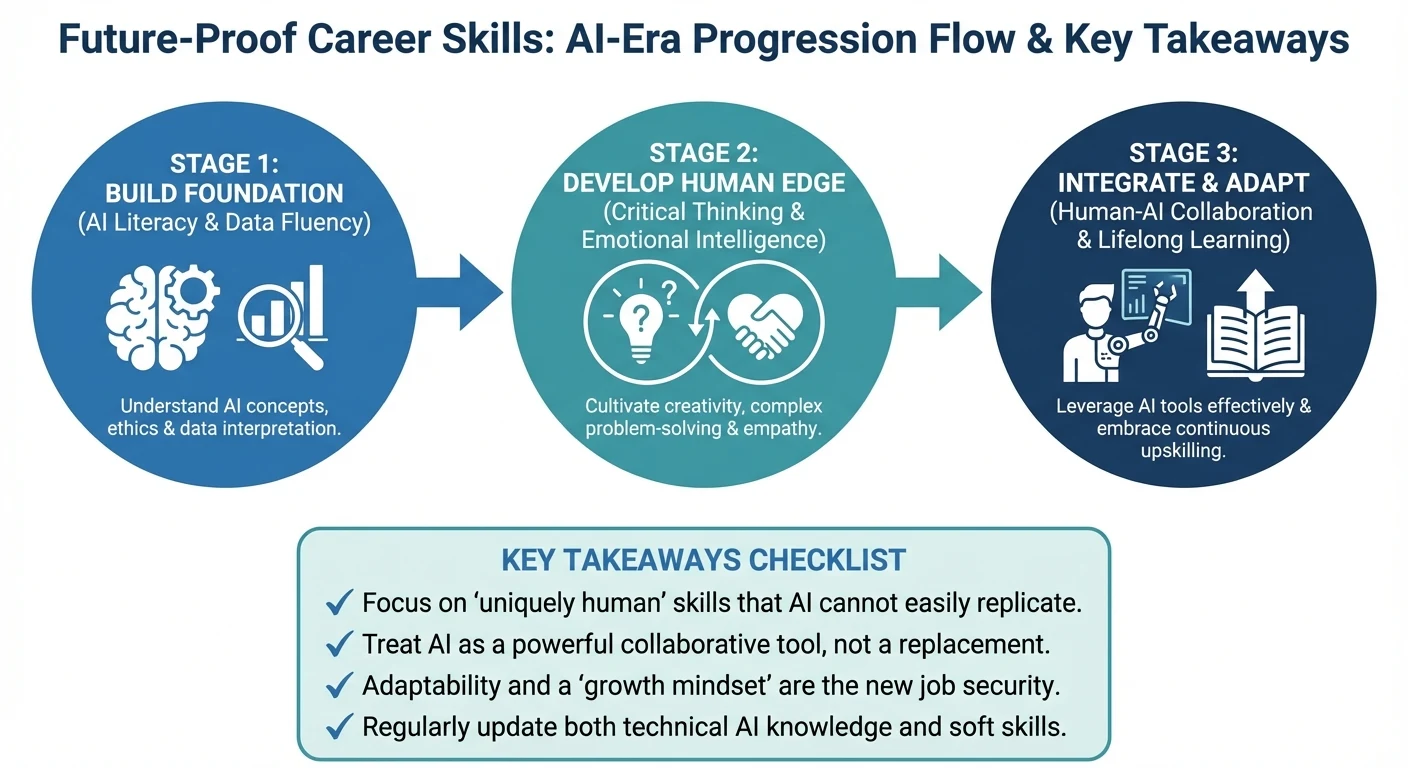
Foundational Skills Before Flashy Ones
Digital literacy comes first. This isn't just about being good at using apps. It's the ability to understand data, filter information, and critically evaluate AI-generated results rather than blindly accepting them. In an environment saturated with misinformation, this skill isn't just a digital proficiency; it's closer to a survival instinct and is likely to become a fundamental competency in almost every role in the AI era.
Next is critical thinking and problem-solving skills. While AI can process data rapidly, the role of interpreting context and deciding which solution is appropriate still belongs to humans. This is why the ability to connect information to actual decisions becomes more important than simply knowing a lot of information.
Third is self-directed learning ability. The idea that the future society will be one where individuals define problems and learn independently is frequently discussed in educational circles. The ability to autonomously set goals, plan, monitor, and evaluate your learning process is crucial for consistency. What you learn is less important than having a structure in place to keep learning—that's the more enduring competitive edge.
Preparing Isn't About Accumulating a Lot in Advance
If you immediately pictured three certifications, five courses, and one portfolio, you might be heading in the wrong direction. The preparation needed now isn't about accumulating more than others; it's about creating a structure now that allows you to learn quickly when change arrives.
The same applies to digital literacy. You don't need to become a developer; the starting point is practicing how to identify which parts of your current work can be automated and which require human judgment.
A Realistic 3-Step Roadmap
Setting a massive plan from the start can easily lead to burnout. Begin small and specific for sustained progress.
Step 1 — Understand the Structure of Your Work. Divide your current tasks into three categories: repetitive tasks, judgment-based tasks, and collaborative tasks. Just this distinction will make it much clearer where to focus your energy. If you have a high proportion of repetitive tasks, prioritize using digital tools; if you have many judgment-based tasks, focus on developing data interpretation and problem definition skills first.
Step 2 — Focus on One Thing at a Time. Trying to tackle AI, data, writing, and foreign languages all at once almost always leads to failure. Simply focusing on the three competencies mentioned above, one by one, is sufficient.
Step 3 — Turn it into a Weekly Routine. Four 30-minute sessions a week will actually be more sustainable than cramming for two hours once. Documenting what you've learned allows knowledge to build up as experience. A one-sentence summary of what you read, your thoughts after trying an AI tool, or a small example of applying it to your work – this is enough.
Career Planning Isn't About a Grand Transformation
It's common advice from many recruitment experts that career planning helps concretize vague goals from a medium-to-long-term perspective. Especially in times when entry-level hiring is decreasing and the market is fluid, it's advantageous not to stick to a single path, whether that means internships or experience in smaller organizations.
Preparing for the future isn't a declaration to completely reinvent yourself. Today's small learnings accumulate to qualify you for your next role. Small accumulations ultimately go further than giant leaps.
Note: The pace of AI change and its impact on roles vary significantly across industries. It's more realistic to adjust any roadmap to fit your specific work and goals rather than following someone else's exactly.
The Smallest Step You Can Take Today
From your current work, jot down one part that seems likely to be automated, and one part that absolutely requires human judgment.
This will give you a direction for your learning. Applying one AI tool to your work this week, reading an article in your field of interest and summarizing it in your own words, or marking study time on your calendar – doing just one of these means your preparation has already begun.