AI Travel Korea: Your Guide to Smarter Trip Planning in 2026
You've got two weeks of vacation, a one-way ticket to Incheon, and a spreadsheet of must-see spots that's already longer than your actual trip. The real problem isn't finding things to do in Korea — it's narrowing them down, sequencing them into a realistic itinerary, and figuring out which temple is closed on Tuesdays before you're standing at the gate. That's exactly where AI tools are starting to earn their keep.
South Korea's tourism infrastructure has been rolling out dedicated AI travel assistants at a surprising pace. Seoul launched an AI chatbot on its official Visit Seoul app in February 2025, Incheon followed with its own AI Travel Assistant in January 2026, and the Korea Tourism Organization's AI-powered recommendation engine has been running since late 2022. This article walks you through what each of these tools actually does, how to get useful results from them, and where they still fall short — so you can decide which ones are worth your time before your trip.
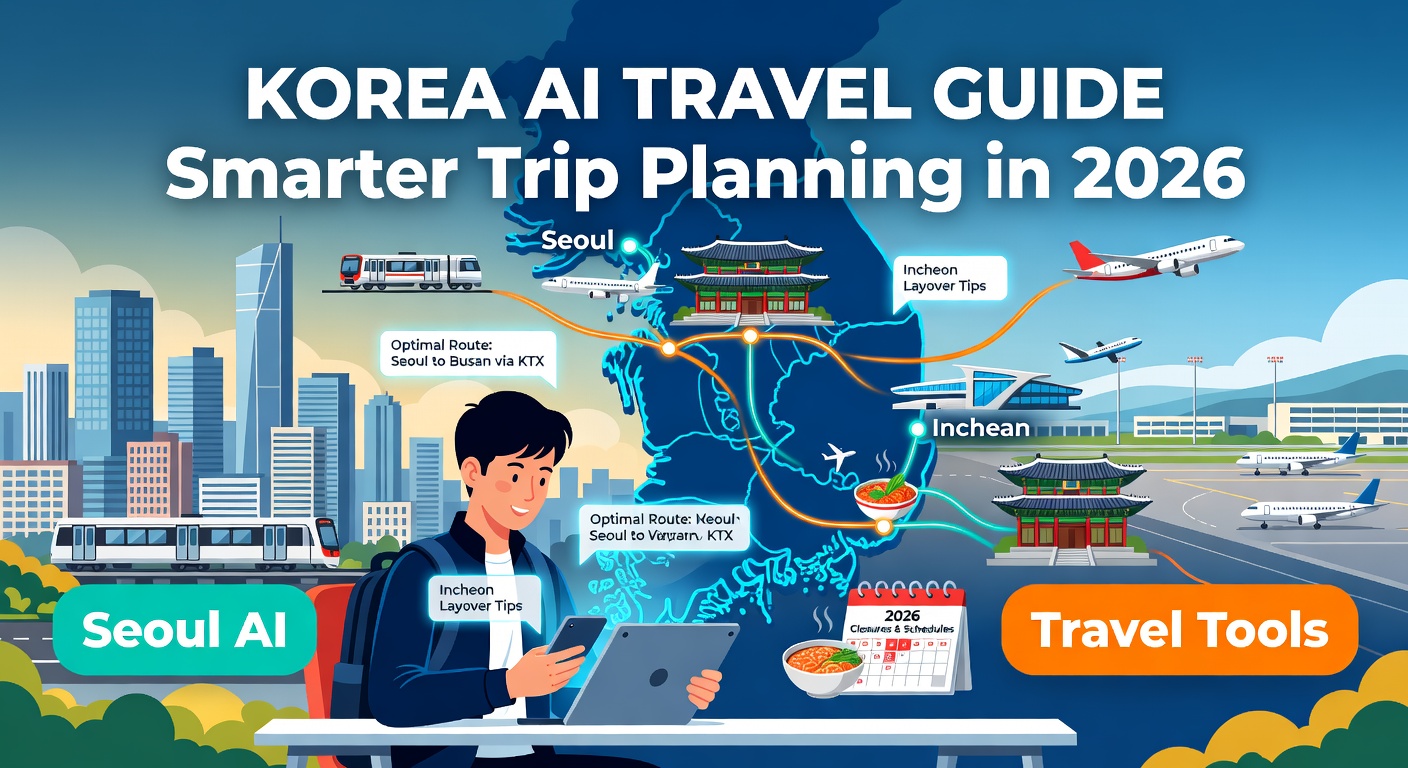
What AI Travel Tools Are Actually Available in Korea Right Now
The first thing that trips people up is assuming there's one big AI travel app for all of Korea. There isn't. Instead, you're looking at a patchwork of city-level and national-level tools, each with different data sets and strengths.
Korea Tourism Organization's "Travel KokKok" (여행콕콕) has been the longest-running option. Launched in late October 2022, it uses public data and big-data analytics to recommend domestic travel routes and destinations. Think of it as the broadest tool — it covers the whole country but won't always have hyper-local details like whether that Busan seafood restaurant changed its hours last week.
Visit Seoul's AI Chatbot rolled out in February 2025 as a pilot inside the Visit Seoul app. According to reporting from the Korea JoongAng Daily, it draws on roughly 30,000 data entries from the Seoul Tourism Foundation's official database, covering restaurants, attractions, events, and transit information. It supports Korean, English, Japanese, and both simplified and traditional Chinese.
🔗 Korea JoongAng Daily — Visit Seoul Chatbot
Incheon's AI Travel Assistant is the newest entry, launching on January 29, 2026 inside the IncheonEasy app. It uses generative AI to analyze your question's intent and context, then suggests customized routes, restaurant picks, and daily schedules. It's still in pilot mode, so expect some rough edges.
🔗 Incheon Metropolitan City — AI Travel Assistant
Then there are general-purpose AI chatbots — tools like ChatGPT, Claude, or Perplexity that aren't Korea-specific but can draft itineraries, translate menus, and brainstorm ideas quickly. They're flexible but lack verified local data, which matters more than you'd think when you're trying to figure out whether a temple requires advance reservations.
The common confusion here: many people assume these government-backed AI tools work like Google Maps with a chat layer on top. They don't. They're recommendation engines, not real-time navigation tools. You still need Naver Map or KakaoMap for turn-by-turn directions once you know where you're going.
How to Actually Get Good Results from Korea's AI Travel Assistants
The quality of what you get back depends almost entirely on what you ask. This is where most first-time users get frustrated — they type something vague like "recommend things to do in Seoul" and get a generic list they could have found on any travel blog.
Here's what works better: be specific about your constraints. Instead of "plan my Seoul trip," try something like: "I have 3 days in Seoul, traveling solo, I prefer indoor activities, and I'm on a budget under 50,000 won per day." The AI assistants from Seoul and Incheon are designed to parse context and intent, so feeding them concrete details produces dramatically better output.
Date and weather matter. If you're visiting during monsoon season (typically late June through mid-July), mention it. If you're arriving on a Monday, say so — many museums in Korea close on Mondays, and a good AI tool should factor that in. The more constraints you give, the more the recommendations shift from tourist-brochure generic to actually useful.
Layer your questions. Start broad to get a route framework, then follow up with specifics. Ask for a 3-day outline first, then drill into "what's the best lunch spot near Gyeongbokgung that's open on Wednesdays and takes card payments." This iterative approach works well with both the government chatbots and general-purpose AI tools.
One thing that catches people off guard: the government AI tools tend to recommend official tourist attractions heavily. If you're looking for the kind of neighborhood cafe or hidden alley market that travel influencers post about, a general-purpose AI chatbot might actually surface those faster — just verify anything it suggests against Naver Map reviews before committing.
Comparing Korea's AI Travel Tools Side by Side
Choosing which tool to open first depends on where you're going and what kind of trip you're planning. Here's how they stack up:
| Feature | Travel KokKok (KTO) | Visit Seoul Chatbot | Incheon AI Assistant | General AI (ChatGPT, etc.) |
|---|---|---|---|---|
| Coverage area | All of South Korea | Seoul only | Incheon only | Global (not Korea-specific) |
| Data source | Public tourism data + big data | ~30,000 official entries | Incheon city data (pilot) | Web training data, not verified |
| Language support | Primarily Korean | KR, EN, JP, ZH (simplified + traditional) | Check app for latest | 50+ languages |
| Best for | Multi-city domestic itineraries | Seoul-focused trip planning | Incheon airport stopovers, Incheon stays | Quick drafts, translation, brainstorming |
| Main limitation | Less granular local details | Seoul only; still evolving | Pilot stage; limited scope | No verified Korean data; can hallucinate |
| Access | Web / app (대한민국 구석구석) | Visit Seoul app | IncheonEasy app | Web / app |
The practical takeaway: if your trip is Seoul-heavy, start with Visit Seoul's chatbot for verified attraction and restaurant data, then use a general AI tool to fill gaps and draft your day-by-day schedule. If you're doing a broader Korea circuit, Travel KokKok gives you the nationwide route framework, and you supplement with city-specific tools as needed.
Using General AI Tools to Fill the Gaps
Korea's official AI assistants handle curated recommendations well, but they're not designed to do everything. General-purpose AI tools pick up where they leave off — and honestly, this is where much of the real practical value shows up.
Itinerary drafting is the most obvious use. Paste in your flight times, hotel location, and a rough list of must-sees, then ask the AI to arrange them into a logical daily schedule with transit times between stops. Most general AI tools can factor in Seoul's subway system reasonably well, though you should always double-check travel times on Naver Map (which accounts for real-time transit schedules more accurately than any AI currently does).
Menu translation is another high-value use case. Take a photo of a Korean menu, upload it to an AI with image recognition, and get not just translations but context — what the dish actually tastes like, whether it's spicy, and what to order if you have dietary restrictions. This beats generic translation apps because you can ask follow-up questions.
Navigating Korean booking platforms is where many travelers hit a wall. Sites like Naver Booking, Klook Korea, or even restaurant reservation apps like Catch Table are often Korean-first in their interface. An AI chatbot can walk you through the screens step by step if you describe what you're seeing or share screenshots.
A common frustration: people use AI to generate a packed 5-day Seoul itinerary, then realize on day two that they've scheduled three neighborhoods that are an hour apart by subway. AI tools tend to optimize for variety, not geography. Always plot your AI-generated itinerary on an actual map before committing to it.
What AI Still Can't Do Well for Korea Travel
It's worth being honest about the limits. Knowing where AI falls short saves you from the kind of trip disruptions that no amount of technology can fix after the fact.
Real-time availability is the biggest gap. None of these tools — government or commercial — can tell you whether a specific KTX train has seats left, whether a hanok guesthouse is booked out for Chuseok weekend, or whether the cherry blossoms in Jinhae are actually blooming this week versus next. For anything time-sensitive, you still need to check Korail's booking site, the accommodation platform directly, or weather-dependent resources like Korea's cherry blossom forecast pages.
Regional accuracy varies significantly. Seoul's AI chatbot sits on 30,000 data entries. Incheon's is in pilot mode. Smaller cities like Jeonju, Gyeongju, or Sokcho have no dedicated AI travel assistant at all — and Travel KokKok's nationwide data can be thinner outside major metro areas. If you're heading to a smaller destination, cross-reference AI suggestions with blog reviews on Naver (search in Korean for better results) or community forums.
Cultural context is still thin. AI can tell you that Bukchon Hanok Village is a popular attraction. It probably won't tell you that residents there have been increasingly frustrated with tourist noise, that certain alleyways have "quiet please" signs, or that the best time to visit is early morning before the crowds. This kind of lived-experience context still comes from human travel writers and recent visitor reviews, not AI databases.
Many people find the language barrier issue confusing in this context — they assume that because an app supports English, all the underlying data is available in English too. That's often not the case. Visit Seoul's English chatbot works well, but when it links you to a Naver Map listing or a Korean-language event page, you're back to needing translation help. Plan for a layered approach: use the AI chatbot for discovery, then a translation tool for the Korean-language pages it points you toward.
A Practical AI Travel Workflow for Your Korea Trip
Rather than picking just one tool, the most effective approach stacks them based on what each does best. Here's a workflow that pulls the strengths of each together:
Before your trip (1-2 weeks out): Start with a general AI tool to draft your overall itinerary framework — how many days in Seoul versus Busan, what themes each day covers, rough budget estimates. Then run your Seoul days through the Visit Seoul chatbot for verified restaurant and attraction picks. Use Travel KokKok for any intercity route suggestions.
During booking: Use AI to help navigate Korean-language booking platforms by describing what you see on screen and asking for step-by-step guidance. Confirm actual prices and availability directly on the booking site — never trust an AI-generated price quote.
On the ground: Keep a general AI chatbot handy for instant translation, menu decoding, and quick "what's near me" questions. For Seoul-specific queries, the Visit Seoul chatbot is a faster path to verified answers. If you're transiting through or staying in Incheon, open IncheonEasy to see what the AI assistant suggests for your layover or stay.
After each day: Ask your AI tool to adjust tomorrow's schedule based on what you didn't get to today. This rolling re-optimization is one of the most underused benefits of AI trip planning — your itinerary doesn't have to be static.
🔗 Visit Korea — Official Tourism Portal
Where This Is All Heading
Korea's 2026 tourism strategy positions AI as core infrastructure, not a novelty feature. According to reporting from The Korea Times, industry experts and the Tourism Sciences Society of Korea are pushing for AI-driven demand forecasting, personalized multilingual services, and smarter tourist flow management across the country.
🔗 The Korea Times — Korea's Tourism Strategy and AI
What this means practically: expect more cities to launch their own AI travel assistants over the next year or two, with better multilingual support and deeper data sets. The gap between what Seoul offers and what a smaller city like Andong can provide will likely narrow, but it won't close overnight.
For now, the smart move is to use these tools for what they're good at — structured recommendations, itinerary drafting, translation, and navigation guidance — while keeping your critical thinking engaged for real-time decisions, cultural nuance, and the kind of spontaneous discovery that makes travel worthwhile in the first place.
Your Korea trip doesn't need to be perfectly optimized by an algorithm. But having an AI assistant that knows the subway map, the restaurant data, and the holiday calendar? That's the difference between spending your first afternoon in Seoul figuring out logistics and actually enjoying it.
Frequently Asked Questions
Q. What is the best AI app for planning a trip to Seoul?
The Visit Seoul app's built-in AI chatbot is currently the most reliable option for Seoul-specific trip planning. It draws from approximately 30,000 verified entries covering restaurants, attractions, and transit, and supports English, Japanese, and Chinese alongside Korean. For broader itinerary drafting that covers multiple cities, pairing it with a general-purpose AI chatbot gives you the best of both worlds.
Q. Can AI translation apps handle Korean menus and signs?
Modern AI tools with image recognition can translate Korean menus and signs with reasonable accuracy, especially for common dishes and standard signage. However, handwritten menus, regional dialect terms, and specialty dish names can still produce awkward or misleading translations. It helps to upload a photo and ask follow-up questions about what a dish contains rather than relying on a one-line translation.
Q. Is the Incheon AI Travel Assistant available in English?
Incheon's AI Travel Assistant launched in January 2026 inside the IncheonEasy app as a pilot project. Language support details may still be evolving since the service is in its testing phase. Check the app directly for the latest supported languages, and keep in mind that pilot-stage features can change or be temporarily unavailable.
Q. How accurate are AI-generated Korea travel itineraries?
AI-generated itineraries are useful as starting frameworks but consistently need human adjustment. The most common issue is geographic spacing — AI tools tend to suggest attractions spread across distant neighborhoods without accounting for realistic transit times. Always plot your AI itinerary on Naver Map or KakaoMap to check travel distances, and verify opening hours and holiday closures directly with each venue.
Q. Do I need to download separate apps for each Korean city's AI travel tool?
Yes, Korea's AI travel assistants are currently city-specific. Seoul uses the Visit Seoul app, Incheon uses IncheonEasy, and the Korea Tourism Organization's nationwide Travel KokKok service runs through the 대한민국 구석구석 (Korea Tourism) app and website. There is no single unified AI travel app for all of Korea yet, so downloading the relevant app for your primary destination is the most practical approach.
IT Engineer · Content Creator
Practical guides based on official sources — simple and actionable.
View all posts →