You've probably experienced it: watching a YouTube video on your commute, listening to a podcast on the go, only to find the next day that what you consumed is a blur. That feeling of having seen it, but retaining nothing.
The problem isn't a lack of willpower. It's that the content you've watched and listened to isn't reconnected within your day.
This is why the 2026 self-improvement trend is shifting from 'adding more new things' to 'connecting the content you already consume into a routine.' Harper's Bazaar Korea points out that in a rapidly changing work environment, self-development is no longer an option but an integral part of life management. What busy professionals need now isn't more study hours, but a structure that allows what they already watch and listen to accumulate continuously.
Why Do We Consume So Much Content But Retain So Little?
The era when learning didn't accumulate due to a lack of information is long past. The problem now is actually having too much, which breaks the flow.
If you just save videos, play audio in the background while your mind wanders, and scatter your notes everywhere — you're left with the feeling of having learned, but nothing has truly accumulated. Adding another subscription in this state will only repeat the same pattern.
What various resources on self-improvement routines consistently emphasize is encountering the same topic two or three times in different ways within a single day. This is where the idea comes from that even short, consistent repetitions of 20 minutes a day can significantly boost your professional acumen and job comprehension in the long run. What you need isn't more content, but a path for what you've watched and listened to to cycle back into your day.
The Content Routine: Repetition Paths Matter More Than Schedules
A routine doesn't need to be complicated. The simplest form looks like this:
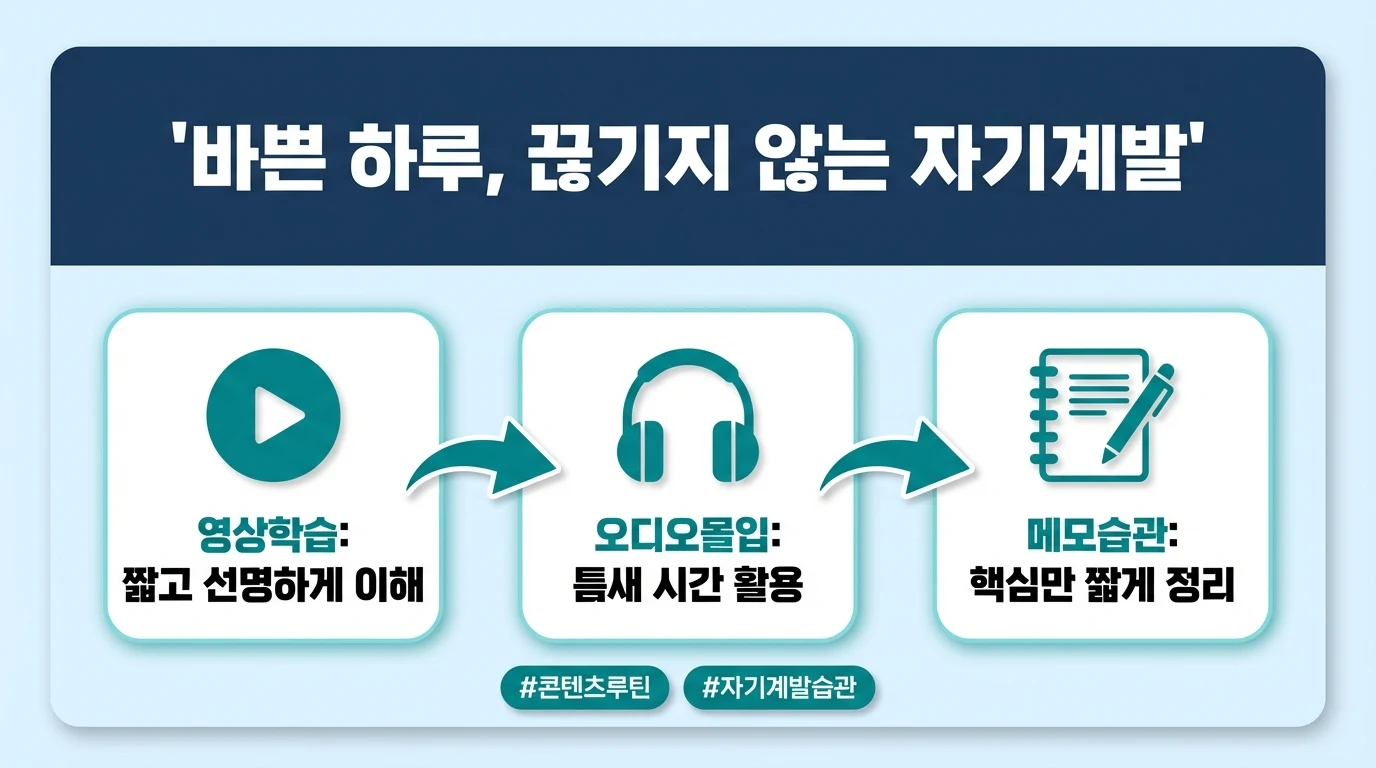
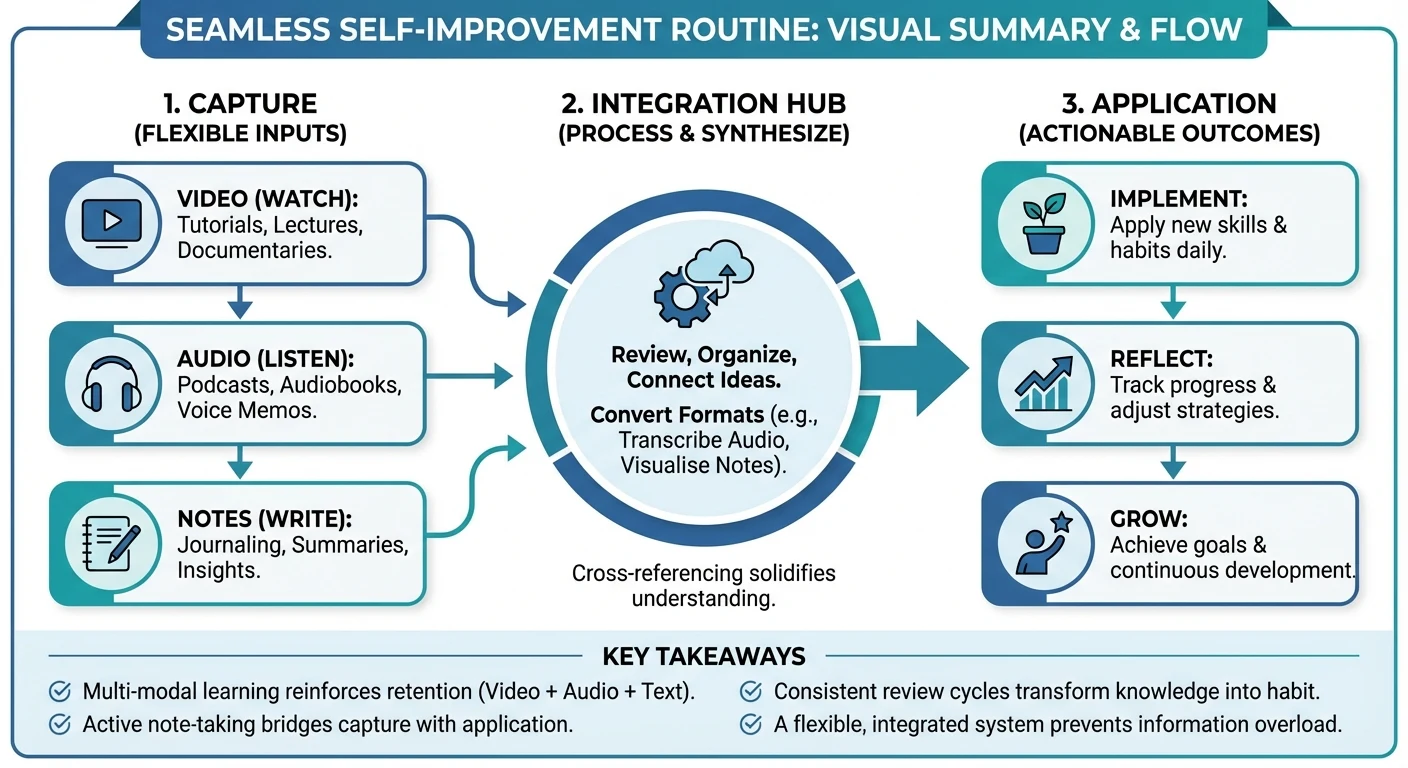
- Morning or Before Lunch: One short video to grasp today's core concept
- Commute Time: Re-engage with the same topic via audio
- Evening 5 minutes: Summarize the core idea in 3 lines of notes or one sentence that reflects your understanding
The core of this structure isn't perfect execution. It's about ensuring the same topic appears in different formats at least twice within a day. Productivity tools like Notion are useful not because of their fancy features, but because they help consolidate scattered notes in one place.
It's okay to miss the morning video. Even just listening to audio during your commute keeps the flow going. If you miss the audio too, a quick review at night is enough. The strength of a routine is that even if your day goes awry, the entire system doesn't collapse.
Video Learning: Watch Briefly, React Actively to Retain
Videos are advantageous for quickly grasping concepts because they engage both eyes and ears simultaneously. Research shows that learners' comprehension and retention improve when they receive both visual and auditory stimuli, and effective educational videos typically focus on 1-2 core ideas per scene and are an appropriate length of 5-15 minutes.
There's one easily overlooked point: watching a video twice in a row offers little learning benefit. Instead, actively reacting by pausing to ask yourself questions during the video, or immediately testing yourself after watching, is far more effective.
Here's how to practice:
- Before watching: Set one question, e.g., "What's the one thing I want to understand from this?"
- During watching: Try to articulate the core idea in a single sentence.
- Immediately after: Leave one question instead of a full note.
While video is a powerful entry point for understanding, it doesn't automatically solidify memories. That role is taken over by audio.
Audio Immersion: Reclaiming Scattered Time, Not Setting Aside New Time
The strength of audio is that it doesn't require you to carve out separate time. You can continue intellectual stimulation even when your hands and eyes are occupied, such as while driving, exercising, or doing housework. While it might be hard to free up 30 minutes at your desk, 15 minutes of commuting is already built into your day.
However, audio isn't a substitute for video; it's a complement. Video is better for learning new concepts, while audio is well-suited for reinforcing content you've already encountered. Auditory cues like intonation, rhythm, and vocal emphasis gradually clarify concepts that might have remained vague.
This is why the flow of understanding with video and reinforcing with audio is the best combination for a busy daily life.
Practical Structure: How to Link Content So the Flow Remains, Even on Off Days
| Time Slot | Method | Key Point |
|---|---|---|
| Morning 10 mins | 1 Video | Quickly grasp new concept |
| Commute 15-20 mins | 1 Audio | Re-listen to same topic |
| Evening 5 mins | Notes or Self-Test | Confirm understanding |
Reports indicate that by 2026, support for AI and digital competency-building online public courses for employed individuals will expand. Technological trends like microlearning, learning analytics, and personalized learning path recommendations also support this direction. Applied to personal routines, the conclusion is the same: learning in short, frequent bursts, repeating the same topic in various formats, is far easier to sustain than trying to learn everything in one long session.
Using AI Learning Tools: Wiser, Not Just Smarter
There are instances where AI-powered learning systems have analyzed individual patterns to recommend optimal paths and contributed to reducing dropout rates. The potential is clear.
However, overreliance requires caution. Concerns are also raised that AI isn't a cure-all, and it could categorize learners into fixed levels or further marginalize those with low digital accessibility.
Note: When using AI learning tools, refer to recommended paths but adjust your final routine yourself. Actual comprehension and sustainability take precedence over scores or analytical results, and it's best to handle learning records conservatively to avoid including sensitive personal information.
AI isn't a tool that lives your routine for you. It's an auxiliary device to refine your routine. Consistency, ultimately, is built more by how you use technology than by the technology itself.
In Closing
Starting tomorrow, you have one task: watch one video, listen to one audio on the same topic during your commute, and jot down three lines of notes at night. That alone will create 'a day of continuous learning.'
The essence of a content routine isn't about consuming more. It's about connecting what you're already watching and listening to within your day.