Why This Feels Personal in Korea Right Now
You update your resume for a job in Seoul, open another AI tool, and start wondering what you still offer that software cannot. Or you land in Korea for study, work, or a longer stay and notice that every conversation about business, education, semiconductors, and startups seems to come back to AI. The question gets practical very quickly: in one of the world's most tech-forward countries, what still makes a human being valuable?
In South Korea, that question is not abstract. The country passed the Framework Act on AI Industry Promotion and Convergence in February 2024, and according to the Ministry of Science and ICT, the law is scheduled to take effect on August 27, 2026. Around the same time, Korean universities have been reshaping programs to train students for an AI-heavy economy. Hanyang University, for example, has highlighted an approach that combines AI expertise with human-centered thinking, not just technical training.
That matters because the message from Korean institutions is surprisingly consistent: AI skills matter, but human skills matter more than many people assume. In a 2025 outlook, the Ministry of Employment and Labor and the Korea Employment Information Service emphasized that work requiring emotional communication, interpersonal relations, and creative problem-solving is likely to become more important as AI spreads. So if you are trying to understand what Human Skills Korea needs now, the answer is not "ignore technology." It is "build the abilities that technology cannot carry by itself."
The rest of the story is where this becomes useful for daily life in Korea, not just for headlines.
Korea's AI Push Is Real, Fast, and Structural
South Korea is not merely experimenting with AI on the side. It is building policy, education, and industrial strategy around it. In early March 2026, the Korean government said it would strengthen national competitiveness in AI semiconductors by designating the sector as a core strategic technology and investing about KRW 600 billion. That is a concrete sign of how seriously Korea sees the AI race.
If you live in Korea or follow Korean industry, you can already feel the direction of travel. AI is showing up in office workflows, translation, customer support, coding, design drafts, education, and content production. Business coverage in Korea has also pointed to a simple pattern: repetitive work is easier to automate, while higher-order judgment becomes more valuable. That does not mean every job disappears on the same schedule. It does mean the baseline for being "useful" is shifting.
For foreigners, this creates a strange mix of pressure and opportunity. Pressure, because Korea moves quickly and often expects fast adaptation. Opportunity, because the more tools become widely available, the more value comes from what is harder to standardize: trust, interpretation, relationship-building, taste, judgment, and cultural reading.
That leads to a more important question than "Will AI take jobs?" The better question is: which human abilities carry extra weight in Korea's AI era?
The Human Skills That Matter Most in Korea
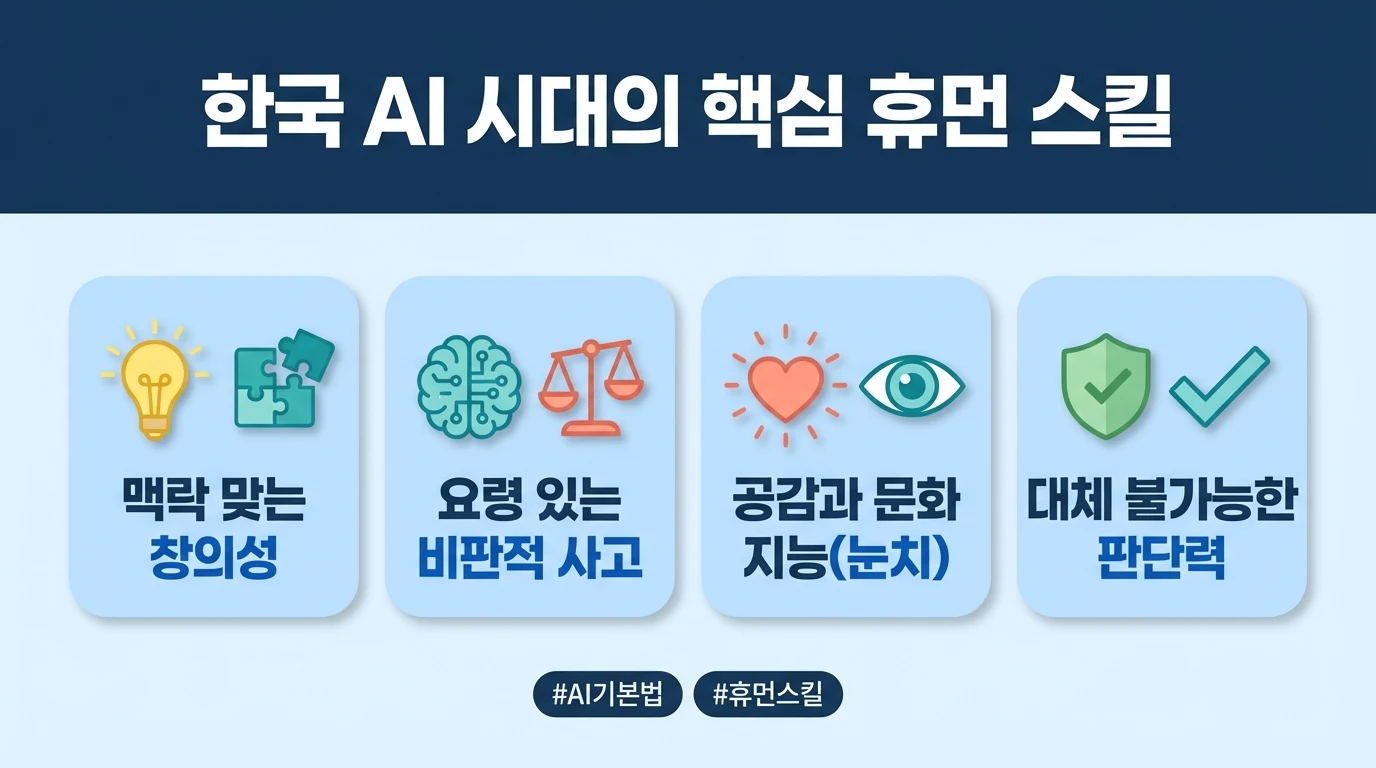
Creativity That Fits Real Context
Creativity in Korea is not only about having original ideas. It is often about producing ideas that fit a real audience, a tight timeline, and a specific social setting. That matters in a country where trends move fast, digital culture is intense, and public response can shift quickly.
In practice, this means the valuable kind of creativity is rarely random. A strong marketer in Seoul, for example, is not just someone who can generate slogans with AI. It is someone who can judge which tone feels right for a Korean audience, which visual style feels tired, and which campaign risks looking tone-deaf. The same goes for teachers, startup operators, editors, product managers, and creators working around K-culture.
AI can generate options. It is less reliable at deciding which option fits the moment. That is why creativity, in the Korean workforce AI discussion, increasingly means taste plus judgment, not just idea volume.
The practical takeaway is simple: if you work in Korea, do not only show that you can make things quickly. Show that you can make things that feel appropriate, timely, and human. That is what turns creativity into actual value, and it opens the door to another skill Korea rewards strongly.
Critical Thinking With Tact
Critical thinking is easy to praise and harder to practice, especially in cultures where hierarchy, team harmony, and indirect communication still matter. In Korea, the challenge is not just "Can you spot a weak idea?" It is also "Can you raise the issue in a way that helps the group move forward?"
This is where many foreigners misread the situation. They hear that companies want innovation and assume blunt disagreement is automatically rewarded. Usually, it is not that simple. In many Korean workplaces, strong critical thinking is most useful when paired with judgment about timing, tone, and audience.
That can mean:
- asking a clarifying question instead of making a frontal objection
- offering two alternatives instead of only criticizing the first plan
- checking whether a senior colleague wants public debate or a private follow-up
- separating "this data looks weak" from "your idea is bad"
As AI tools become better at drafting reports, summarizing meetings, and producing polished-looking answers, critical thinking becomes more valuable precisely because polished answers can still be wrong. AI can sound confident while missing bias, context, or risk. Human beings still need to ask, "What is the assumption here?" "What is missing?" "What would this look like in the real world?"
That matters even more in Korea, where speed can be a cultural expectation. The well-known ppalli-ppalli (빨리빨리, the do-it-fast culture) helps teams move quickly, but fast systems need people who can slow down at the right moment and prevent expensive mistakes. And once you see that, another human skill comes into focus.
Empathy Is Not Soft in the Weak Sense
In AI conversations, empathy is sometimes treated like a nice extra. In real life, especially in Korea, it is often a core operating skill.
Empathy affects how you handle customers, coworkers, landlords, classmates, service staff, and local communities. It helps you read when someone is uncomfortable, confused, embarrassed, or too polite to say no directly. That matters in any country. It matters even more in Korea because social meaning is often carried through tone, pauses, indirect wording, and relationship history.
This is one reason official Korean labor forecasts have highlighted emotional communication and interpersonal ability. If AI handles more of the routine layer, the remaining work often involves friction, uncertainty, and emotion. Someone still has to calm a frustrated client, mentor a junior teammate, explain bad news, negotiate between departments, or notice that a translated message sounds technically correct but socially cold.
Outside work, empathy also shapes everyday expat life in Korea that readers will recognize immediately. You use it when a clinic receptionist seems abrupt but overloaded, when a coworker gives indirect feedback, when a neighbor is formal at first, or when a language exchange partner is trying to save face rather than say "I disagree."
Empathy is not about being endlessly agreeable. It is about reading the human stakes in a situation. And in Korea, that connects directly to cultural intelligence.
Cultural Intelligence and Nunchi
If one Korean concept deserves attention here, it is nunchi (눈치, the ability to read the room and sense what is socially expected without everything being stated directly). Nunchi is not magic, and it is not exclusive to Koreans. It is a practical social skill. In Korea's AI era, it may become even more valuable because it is exactly the kind of subtle, context-heavy ability machines still struggle with.
The cultural intelligence Korea requires goes beyond etiquette. It includes understanding:
- how directly to speak in different settings
- when formality matters
- how age, role, and status affect interaction
- why silence can mean reflection, discomfort, or polite disagreement
- how group harmony can shape decisions
It also includes learning emotional concepts that do not translate cleanly. Jeong (정), for instance, refers to a deep relational warmth that builds over time through shared care, familiarity, and obligation. You do not need to use the Korean word in daily conversation to benefit from understanding it. But if you grasp what it points to, you understand Korea better than someone relying on literal translation alone.
This is where AI in Korea still has limits. A tool can translate words. It often cannot fully interpret social meaning. The foreign professional who develops cultural intelligence becomes valuable not only because they understand Korea better, but because they can also bridge Korea to international teams, clients, and audiences. That bridging role is becoming more important, not less.
And once human skills start creating value like this, the next question becomes practical: how do they show up in work and daily life?
What This Means for Work in Korea
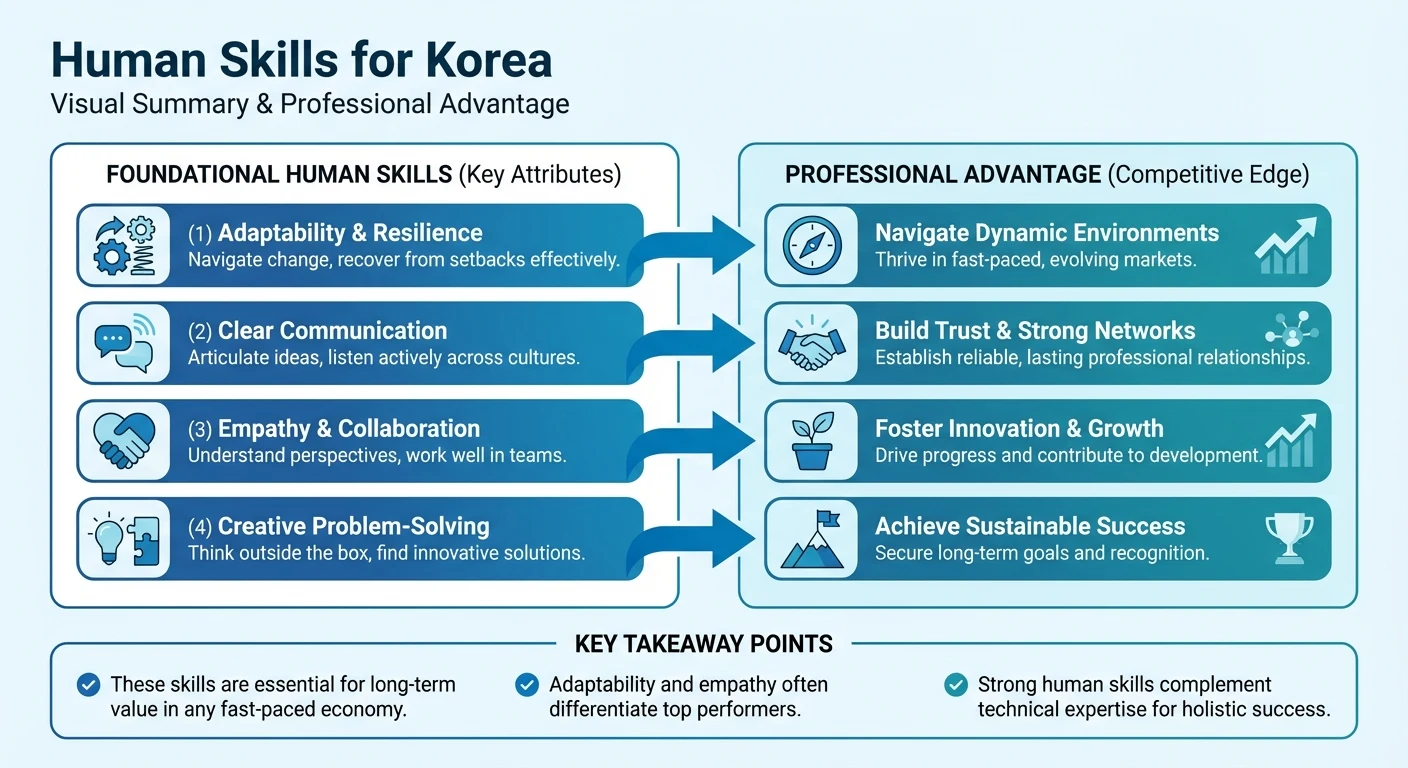
If you want a clean mental model for the future of work Korea is moving toward, try this: the more a task is repeatable, the more AI can help or replace part of it; the more a task depends on trust, nuance, and judgment, the more human advantage remains.
That does not mean technical skills are optional. Basic AI fluency is becoming part of professional hygiene. You should know how to use AI tools to research, summarize, draft, and test ideas. But in Korea, being "the AI person" is less durable than being the person who can use AI while still handling ambiguity with people.
For office workers, that means your value rises when you can:
- explain complex information clearly across language or department gaps
- spot weak assumptions before they become group decisions
- manage tone in emails, meetings, and client communication
- build trust across hierarchy, not only with peers
- adapt one message for Korean and international audiences
For job seekers, it means your application should not only list software or certifications. Show evidence of problem-solving, collaboration, leadership, or customer understanding. If you worked across cultures, say how. If you resolved conflict, improved a process, trained colleagues, or communicated between teams, spell that out. Those examples make your human skills visible.
For students and early-career professionals, the pattern is similar. If Korean universities are already revising curricula to combine AI capability with human-centered thinking, then the market signal is clear. Technical fluency gets you into the conversation. Human depth often determines whether people trust you with meaningful work.
Even freelancers and creators can use this logic. If AI makes average content easier to produce, then original insight, emotional credibility, and cultural feel become more valuable. A travel writer with strong local reading will outperform a generic content mill. A creator who understands fan culture, platform behavior, and emotional tone will have an edge over someone producing endless machine-assisted sameness.
Work, though, is only half the story. The human skills Korea rewards also shape how well you actually settle into life here.
Why Human Skills Matter Outside the Office Too
A lot of foreigners arrive in Korea thinking the hard part will be language or paperwork. Those are real challenges. But many of the most important moments are social, not administrative.
You see this when you search for housing, build friendships, join a hobby group, interact with in-laws, attend a hoesik (회식, a work dinner or drinks gathering that helps build team relationships), or try to understand a conversation that sounds polite on the surface but clearly carries tension underneath. AI can help translate messages or explain vocabulary. It cannot fully handle the emotional and relational layer for you.
This is especially relevant for expat life that Korea can sometimes make feel efficient and isolating at the same time. The trains run well. Apps work. Delivery is fast. But belonging still grows through human signals: showing consistency, noticing other people's comfort, asking questions with respect, following up, and reading when to step forward or give space.
For travelers and K-culture fans, this matters too. A deeper appreciation of Korea does not come only from consuming content or visiting famous neighborhoods. It comes from noticing how people coordinate, care, apologize, include, hesitate, and negotiate. Cultural intelligence makes the country feel less like a spectacle and more like a lived social world.
That is why human skills are not just career assets. In Korea, they are often the difference between being functionally present and genuinely integrated. So the next issue is obvious: how do you actually build them?
Practical Ways to Build Human Skills Korea Rewards
You do not build empathy, judgment, or cultural intelligence through one course or one clever app. You build them through repeated habits. The good news is that Korea gives you plenty of real-world practice if you use daily life well.
Start by improving your observation before your performance. In meetings, classes, cafés, shops, and social gatherings, ask yourself:
- Who speaks first?
- Who actually decides?
- How direct is disagreement here?
- What gets said openly, and what is only implied?
- When people soften language, what are they trying to protect?
This trains nunchi faster than memorizing etiquette lists.
Then work on communication that is clear without being rigid. If you speak Korean at an intermediate level, do not aim only for grammatical correctness. Pay attention to warmth, pacing, and humility. If you communicate mostly in English, remember that many Korean colleagues or friends may understand your words perfectly but still read your tone differently than you intended.
A few practical habits help a lot:
- Before sending an important message, ask: "Is this only correct, or is it also considerate?"
- In meetings, ask one clarifying question before offering disagreement.
- When something feels vague, summarize your understanding out loud instead of pretending you understood.
- After difficult interactions, write down what happened and what social cue you may have missed.
- Use AI to draft or translate, but do a final human pass for tone and relationship impact.
It also helps to put yourself in mixed settings rather than only international bubbles. Join a club, volunteer, take a class, attend local events, or keep a regular neighborhood routine. Repetition builds pattern recognition. Pattern recognition builds confidence. Confidence makes empathy easier, because you are no longer spending all your energy just trying to decode the basics.
If you are career-focused, build a portfolio of human outcomes, not just technical outputs. Keep examples of times you resolved confusion, adapted across cultures, handled customers well, or improved a process by noticing what others missed. In an AI-heavy labor market, those stories become evidence.
One more point matters here: do not overcorrect and become proudly anti-AI. Korea is not moving backward from automation, and you should not present yourself as if human skills and AI skills are competing camps. The strongest position is to use both.
Use AI, But Keep the Human Layer Yours
The people likely to do well in Korea's next phase are not the ones rejecting AI, and not the ones outsourcing all judgment to it. They are the ones who treat AI as a tool for speed while protecting the parts of work and life that require humanity.
Use AI for first drafts, translation checks, summaries, brainstorming, transcription, and repetitive structure. That can save time and reduce friction.
But keep these tasks in human hands:
- final judgment on sensitive communication
- relationship repair
- conflict mediation
- cultural interpretation
- ethical decisions
- audience-specific tone
- strategic choices under uncertainty
This matters because AI often flattens difference. It tends to produce competent averages. Korea, by contrast, often rewards people who can sense specific context: this team, this client, this moment, this status dynamic, this emotional climate.
That is also why you should be careful with dramatic predictions. No one can say with precision which jobs will shrink, transform, or expand first. Education systems are still adapting. Companies vary widely by industry and size. AI systems also carry bias from their training data, which means human review remains essential. The trend is clear, but the timeline is uneven.
A calmer, more useful way to think about the Korean workforce AI transition is this: make yourself harder to flatten. If a machine can produce something similar to your output in seconds, then your edge has to come from context, trust, and originality. Korea's fast-moving AI landscape does not reduce the value of those qualities. It increases it.
The Real Advantage Is Still Human
South Korea is pushing forward on AI with unusual seriousness. The law is moving into force on August 27, 2026. Government investment is rising. Universities are redesigning programs. Employers are changing workflows. None of that suggests a future where people matter less.
It suggests a future where basic competence is more automated, and deeply human competence becomes more visible.
That is why the human skills Korea needs now are not decorative extras. Creativity helps you make work that feels right, not just fast. Critical thinking helps you catch errors dressed up as efficiency. Empathy helps you build trust in a society where indirect signals still matter. Cultural intelligence helps you move from translation to real understanding.
For foreigners living in, visiting, or closely following Korea, this is good news if you take it seriously. You do not need to out-machine the machine. You need to become the kind of person who can use powerful tools without losing judgment, warmth, and social awareness. In Korea's AI era, that is not old-fashioned. It is a durable advantage.