Why Your Stay Matters in Korea
You land in Korea, scroll through booking apps, and realize most rooms look interchangeable. You want your trip to feel like Korea, not like another anonymous city break with the same lobby, the same breakfast, and the same beige walls. The real question is not just where to stay, but what kind of Korea you want to wake up inside.
If you are searching for unique accommodations in Korea, the strongest place to start is with the country's traditional lodging culture. GQ Korea notes that a hanok stay in Korea offers a night inside a traditional Korean house, where historic design and modern comforts now often exist side by side. That matters because many travelers assume "traditional" means inconvenient, when in reality a good hanok can give you carved wooden beams, a courtyard, and ondol (온돌, Korea's traditional underfloor heating) without forcing you to give up basics like private bathrooms or air-conditioning.
The variety is wider than many first-time visitors expect. Tour Toc Toc highlighted several traditional hanok properties across the country that had received Korea Tourism Organization Safe Stay recognition, including places in Tongyeong, Inje, Jeonju, and Gimhae. In Seoul, VisitSeoul points visitors toward Bukchon-area stays such as Rakkojae, Cheong Yeon Jae, Hakminjae, and Tongin 1939, and notes that Cheong Yeon Jae sits between Gyeongbokgung and Changdeokgung and dates back to 1936. This is not a niche gimmick. It is one of the clearest ways to make your accommodation part of the trip itself.
That is why the best unique places to stay in Korea usually come down to experience categories, not hotel star ratings, and hanok is only the beginning.
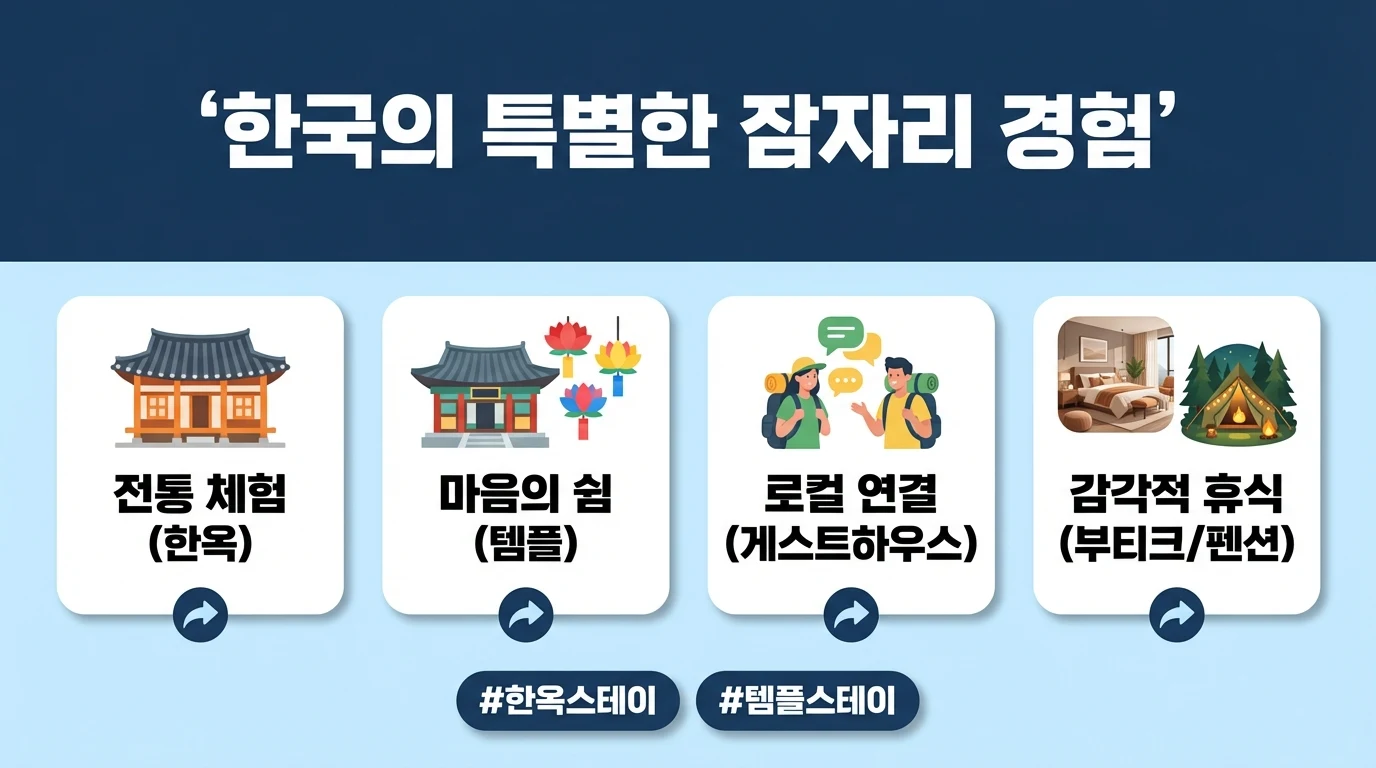
Hanok Stay Korea: Tradition Without Giving Up Comfort
A hanok (한옥, a traditional Korean house) stay is usually the first answer people hear when they ask about special lodging in Korea, and for good reason. A hanok changes the rhythm of your stay. You notice the creak of wood floors, the filtered light through hanji-style windows, the small courtyard, the lower seating, the shoes-off culture, and the quieter pace of the space. Even before you leave for sightseeing, the building itself is already teaching you something about Korean ideas of home, privacy, and balance with nature.
That experience can vary a lot depending on where you book. Some hanok stays are closer to boutique inns. Others feel more like a family-run guesthouse. Some are highly polished luxury properties, while others are simple, old-fashioned, and intimate. This is why it helps to think about the type of hanok you want rather than chasing a generic "traditional stay" label.
Where Hanok Stays Make the Most Sense
Seoul works well if you want convenience and atmosphere together. A hanok in Bukchon or nearby neighborhoods lets you walk to palaces, tea houses, museums, and older alleyways while still sleeping in the middle of the city. If you are short on time, this is probably the easiest way to add cultural depth without changing your entire itinerary.
Jeonju is one of the classic choices if you want a stronger traditional setting. The hanok village atmosphere is more immersive than in most urban neighborhoods, and it suits travelers who want to spend a full day wandering slowly rather than rushing between landmarks.
Gyeongju is ideal if you want history layered on history. Staying in a traditional-style property there pairs naturally with tomb parks, temple visits, and a slower evening pace.
Tongyeong, Inje, or Gimhae make sense if you want a quieter trip and are actively choosing lodging as the destination. Tour Toc Toc's roundup is useful here because it points beyond the usual Seoul-first shortlist.
There is also a more polished middle ground. GQ Korea highlighted Gyeongwonjae Ambassador Incheon as a hanok hotel that combines Korean aesthetics with hotel-level convenience and offers cultural programs such as trying on hanbok and traditional games. That kind of property is especially appealing if you like the idea of tradition but do not want to troubleshoot too many unfamiliar details on your own.
What to Check Before Booking a Hanok
A hanok listing can look beautiful and still be the wrong fit. Before you reserve, check these points carefully:
- Bed or floor bedding: Some rooms use yo (요, a traditional floor mattress) instead of a raised bed.
- Private bathroom: Not every traditional stay has the same setup.
- Sound insulation: Older wooden structures can be quieter in spirit but not always quieter in practice.
- Heating and cooling: Ondol is wonderful in cold weather, but summer cooling matters too.
- Luggage access: Historic neighborhoods often mean narrow lanes, stairs, or limited car access.
- Curfew or check-in rules: Smaller properties may not operate like 24-hour hotels.
If you are traveling with parents, children, or anyone with mobility concerns, do not assume accessibility. That information is often incomplete on booking pages, so it is worth messaging the property directly.
A hanok stay is usually best for one or two nights, especially on a first trip—long enough to feel the texture of traditional living, short enough that any compromises feel intentional. Once you understand what hanok gives you, temple stays start to make sense for a different reason altogether.
Temple Stay South Korea: A Bed Inside a Living Tradition
A temple stay in South Korea is not simply unusual lodging. It is a structured cultural program built around Korean Buddhist life. According to Templestay, the program lets visitors experience the daily rhythm of practitioners within a tradition shaped by roughly 1,700 years of Korean Buddhist history and culture. That distinction matters because people often book a temple stay expecting a scenic mountain hotel with a meditation option. In reality, the experience is closer to entering a living community with its own schedule, etiquette, and purpose.
That is also why it can become the most memorable night of an entire trip. You are not just sleeping somewhere quiet. You are stepping into a different definition of time.
What a Temple Stay Actually Feels Feels
Many temple stays begin with arrival and orientation, followed by tea, meditation, a temple meal, or a simple evening walk around the grounds. The next day may start early—sometimes very early—with bells, chanting, or morning practice. Meals are usually simple and often vegetarian. Silence may be encouraged in certain spaces. Dress is modest. Alcohol, late-night noise, and casual hotel behavior are obviously out of place.
For some travelers, that sounds intense. For others, it is exactly the point.
The good news is that not all programs are equally demanding. Some are highly structured experience-type stays designed for beginners. Others are closer to silent retreat formats. VisitSeoul points out that even temples in Seoul offer chances for reflection with much easier transport, which makes them a smart option for first-timers who want the atmosphere without committing to a remote mountain journey.
If you do want the mountain-monastery version, stronger choices exist there too. K-Buddhism reported that Beopjusa, one of the UNESCO-listed Korean mountain monasteries, offers temple stay experiences including distinctive programs such as singing bowl meditation. That is a good example of how a temple stay can connect spiritual practice, architecture, and heritage in one place.
Who Should Book One, and Who Probably Should Not
A temple stay is a great fit if you want:
- A break from urban pace
- A culturally grounded experience rather than a photogenic one
- Time alone without feeling lonely
- A memorable overnight activity between city stops
It may not be the best fit if you want nightlife, flexible mealtimes, luxury amenities, or complete privacy. It can also be difficult for travelers who are very sensitive to early mornings, floor sleeping, or strict group schedules.
One practical point matters more than most people realize: language support varies by program. Some temple stays are well prepared for international visitors. Others are much easier if you can follow basic Korean or are comfortable with simple instructions and a bit of uncertainty. The official Templestay platform is usually the best place to confirm that before booking.
A temple stay gives you Korea's contemplative side. From there, the rest of the country's diverse lodging scene starts to look less like a random mix and more like a set of distinct travel moods.
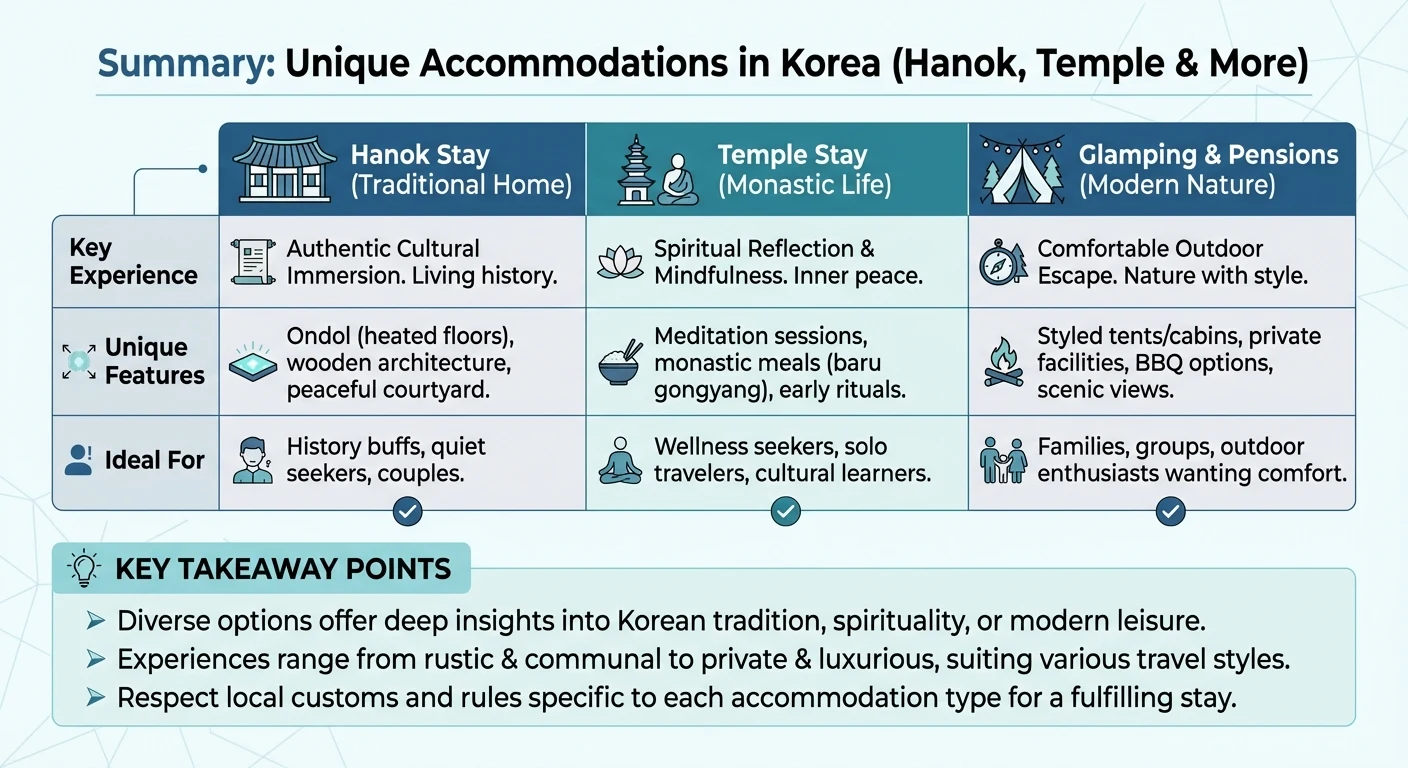
Best Unique Places to Stay in Korea Beyond Hanok and Temples
Not every traveler wants ritual or heritage at the center of every night. Korea also does modern, social, design-led, and nature-based stays well, and this is where the country's diverse lodging options become especially useful.
Korean Guesthouse Stays for Connection and Flexibility
A Korean guesthouse is often the easiest way to make a trip feel local without spending heavily. These properties are common in major destinations, and large booking platforms such as Expedia show just how widely they appear across Seoul, Incheon, Jeonju, Gyeongju, and Busan, even though individual listings and quality levels change quickly.
The appeal is not just budget. A good guesthouse gives you neighborhood context. You may stay in a residential lane, get restaurant tips from the owner, meet other travelers in a shared kitchen, or learn more from a ten-minute conversation than from an hour of travel content online. This is particularly useful for solo travelers, students, remote workers on a short stay, and anyone who wants more human contact than a standard hotel provides.
That said, the word "guesthouse" in Korea covers a wide range. It can mean a polished mini-hotel, a hostel-style dorm, or a family-run minbak (민박, a simple home-style lodging or homestay). Always check whether the room is private, whether the bathroom is shared, and whether check-in is staffed or self-service.
Boutique Hotels Seoul Travelers Should Not Overlook
If your trip is city-first, boutique hotels in Seoul can be one of the best ways to get something memorable without sacrificing comfort. Seoul does design well when the hotel is rooted in its neighborhood. The most interesting small properties tend to reflect the mood of the area around them rather than striving for a globally generic feel.
For travelers who want cafes, galleries, and newer creative energy, neighborhoods like Seongsu can be a better base than a traditional tourist hub. If you want older Seoul with a contemporary edge, Euljiro and parts of Ikseon-dong offer a different atmosphere. If food, shopping, and late-night movement matter most, other central districts may fit better. The hotel itself matters, but in Seoul, the neighborhood often matters more.
The practical advantage of a boutique hotel is that it can give you a strong sense of place without asking you to adapt much. That makes it a good counterbalance if you are pairing one or two more demanding nights—such as a temple stay or a traditional hanok—with the rest of a longer trip.
Pensions, Forest Stays, and Glamping for a Softer Side of Korea
Outside the biggest cities, many travelers end up preferring accommodations that sit closer to nature. In Korea, that often means pensions (펜션, Korean-style private lodges or vacation rentals), forest cabins, seaside stays, or glamping sites.
These options are ideal if your goal is slower travel: grilling dinner outdoors, waking up to mountain air, staying near a national park, or having enough space for a family or group. They are especially popular for weekend escapes and couple trips. In places like Gangwon-do, parts of Jeju, or coastal areas, these stays can become the main reason to go.
The caution is that the most appealing nature stays are often the least convenient without a car. Check the last bus time, grocery access, on-site cooking rules, barbecue fees, weather exposure, and insect screens in warmer months. Beautiful isolation is still isolation.
Once you see these categories side by side, it gets easier to stop asking "What is the most unique stay?" and start asking the better question: "Which one matches the trip I actually want?"
How to Choose the Right Stay for Your Trip
If this is your first trip to Korea, the easiest combination is usually one culturally specific stay plus one comfort-first stay. For example, spend one or two nights in a hanok, then move to a well-located hotel or guesthouse in Seoul or Busan. That gives you depth without creating fatigue.
If you are returning to Korea and want something more immersive, build your route around the accommodation itself. A hanok in Jeonju, a temple stay in the mountains, and a design hotel in Seoul can create three completely different versions of the country in one itinerary.
A simple way to choose:
- Book a hanok if architecture, history, and atmosphere matter most.
- Book a temple stay if you want introspection, ritual, and quiet.
- Book a guesthouse if you want flexibility, local tips, and conversation.
- Book a boutique hotel if you want design, comfort, and a strong urban base.
- Book a pension or glamping stay if rest, scenery, or group travel is the priority.
Season matters too. Hanok and temple stays can feel especially rewarding in spring and autumn, when courtyards, mountain paths, and wooden architecture are at their best. Summer makes cooling and ventilation more important. Winter makes ondol heating a major advantage, but remote locations may require more planning.
The last layer is personality. Some travelers want every night to be part of the story. Others want one memorable stay and then reliable convenience. Neither approach is more authentic. The point is to choose intentionally, because booking the wrong "special" accommodation can feel more tiring than meaningful.
Booking Tips Before You Pay
A few practical checks will save you from most disappointment.
Read the latest reviews, not just the overall score. A beautiful property can still have new issues with maintenance, cleanliness, or staffing. This matters especially for smaller independent stays.
Treat price as unstable. Rates in Korea can shift sharply by season, weekends, festivals, room type, and booking platform. Compare value and experience rather than relying on old price examples.
Verify the experience details directly. Ask about bedding, bathrooms, parking, breakfast, curfews, luggage storage, and language support. This is especially important for hanok stays and temple programs.
Do not assume accessibility or pet policies. Those details are still inconsistent across many listings, especially outside major chain hotels.
Match the stay to your energy level. A temple stay on your first night after a long-haul flight may sound poetic and feel terrible. A guesthouse before an early train may be smarter than a remote scenic lodge.
Use official channels when the experience is program-based. For temple stays, the official Templestay platform is usually the safest starting point. For Seoul-focused traditional stays, city tourism resources like VisitSeoul can help you build a shortlist before checking current booking details.
Those checks may sound unglamorous, but they are what turn a good idea into a genuinely good stay.
Korea Is Better When You Sleep Differently
The most rewarding trips to Korea often come from changing your accommodation, not just your sightseeing list. A hanok stay shows you how Korean space is shaped. A temple stay slows you down enough to notice what travel usually erases. A guesthouse, boutique hotel, or countryside pension can reveal local neighborhoods and rhythms that ordinary hotels flatten out.
If you want unique accommodations in Korea, start with the experience you want to remember in six months. Then choose the room that supports that version of the trip. In Korea, the place you sleep can do much more than hold your suitcase. It can become one of the clearest ways to understand the country itself.